
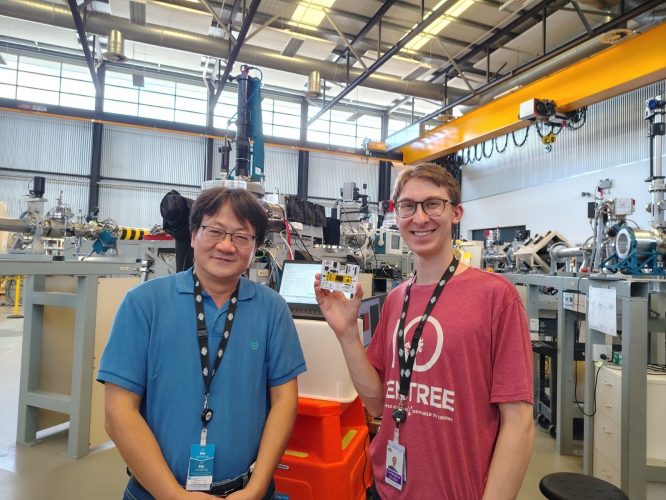
Before semiconductors and microelectronics can be trusted in space, designers need evidence that their components can withstand radiation. Saskatoon-based Novigrad Technologies is helping provide that assurance through a business built on graduate research, academic mentorship, and access to tools provided by CMC Microsystems through the FABrIC project.
Christopher Elash and Lars Kishchuk founded the company to test and qualify mission-critical electronics for radiation effects in space, aerospace, defence, and other high-reliability applications. Elash said Canadian customers are looking for domestic testing options. “Our focus right now is serving this underserved market in Canada,” he said.
Research that became a business
Novigrad emerged during the pandemic, when a difficult job market led Elash to consider graduate studies. Seeking out a graduate supervisor led him to Li Chen, whose research includes radiation effects in microelectronics and who leads the Semiconductor Technology and Rad-Effects Research Lab at the University of Saskatchewan. Chen became more than a PhD supervisor, Elash said. “It ended up being a lot more than that.”
Elash gained experience at beamline testing facilities, then moved into semiconductor design and test-chip development. That combination of device physics and practical investigation into radiation’s effects on electronics became the foundation of Novigrad’s services.
Chen continues to provide advisory services, linking the research that trained Elash with the company now applying that knowledge.
Understanding what can go wrong
Novigrad’s work focuses on a vulnerability that becomes significant when individual particles interact with tiny transistors.
A single particle can strike a chip and cause glitches, corrupt data, or trigger device failure, Elash said.
Novigrad uses controlled, accelerated ground testing to help predict reliability over a component’s deployed lifetime. Its applications include space electronics, avionics, and other high-reliability systems, with opportunities extending to terrestrial electronics such as automotive systems and data centres.
One customer was concerned about trace radioactive contaminants in a chip’s plastic packaging, while atmospheric neutrons can cause data errors in automotive systems and data centres. The company also serves Canadian space and avionics firms seeking to keep technology and expertise in the country. “They have a really strong Canadian focus, and they want to keep the technology and the people doing the work within Canada,” Elash said.
For now, the company is focused on qualification and testing for Canadian customers, with proprietary hardware or silicon IP as a longer-term ambition.
Although Novigrad sells testing services rather than chip designs, Elash’s research background remains essential to planning and conducting tests and interpreting the results.
CMC tools in action
CMC gave Elash access to professional electronic design automation tools, including Virtuoso, Spectre, and QuestaSim, while fabrication services gave him experience with physical test chips.
Students could not realistically obtain these resources independently, Elash said, making CMC support “a hidden gem” for Canada’s semiconductor industry. “The barrier to entry is so high,” he said. “Without having access to all the tools and being able to do real engineering design and then tape out the chips through their multi-project wafer (MPW) service, I would have never gotten all the skills and experience and knowledge that I have.”
CMC’s tools and resources benefit more than graduate students, Elash said. They also help small companies avoid expensive equipment purchases.
CMC’s Virtual Incubator Environment provides engineering help, fabrication access and test-equipment rentals when unusual customer requirements arise. “It doesn’t always make sense for us to buy this extremely expensive and unique equipment,” Elash said. CMC access can let a business complete specialized work without bearing the full purchase cost, he added.
Building on that foundation
Elash and Kishchuk’s entrepreneurial interests developed during the University of Saskatchewan’s first CubeSat project, where engineering responsibilities came alongside finances and team decisions. Novigrad brings that experience into a commercial setting.
As Novigrad grows, Elash sees CMC supporting its next phase through tools, fabrication services and the FABrIC program. “It reduces the barrier to entry for semiconductor design and work,” he said.
November 2026